
By the time we reached the beach, the day had already begun to fold itself away.
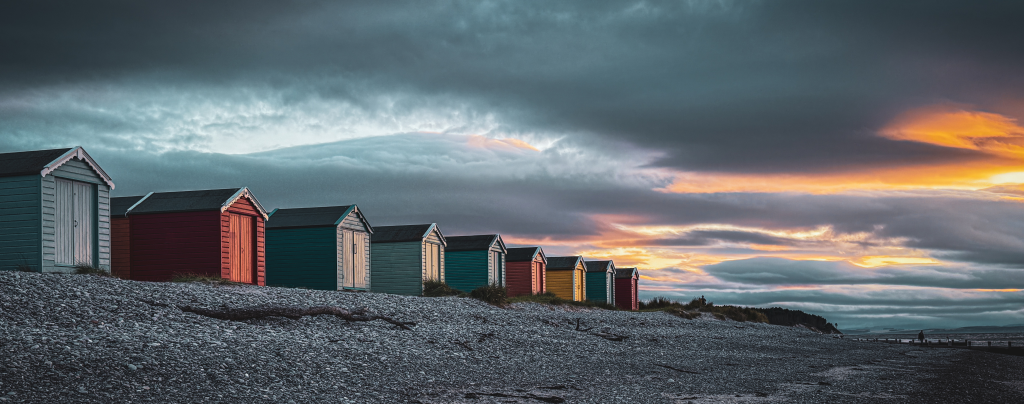
The light had lost the brightness of late afternoon, replaced by the softer colors that arrive just before sunset on the Moray Firth. A row of painted beach huts stood above the stones, each one facing the sea with its door closed for the evening. Their colors shifted as the light changed. One caught the last of the sun while the next was already in shadow.
Diane stopped for a moment and looked back along the line.
From where we stood, the huts became progressively smaller until they disappeared into the curve of the shoreline. Neither of us said anything. After a few moments we turned toward the water and started walking.
There was nowhere either of us needed to be.
Findhorn is not the sort of beach that immediately demands attention. There are no cliffs rising above the shore or heavy surf breaking against the land. Instead, the coastline stretches quietly along the Moray Firth, covered almost entirely with smooth, rounded pebbles that have spent years being carried back and forth by the sea.
We drifted toward the water where the pebbles became smaller and the walking a little easier.
Every step set hundreds of stones shifting beneath our feet. They clicked softly against one another before settling again, while the tide moved in and out a few yards away, occasionally washing over the pebbles before drawing them back with a faint rattling sound.
For a while we said very little.
That has become one of the quieter changes that comes with spending so many years together. Earlier in life, silence often invited another question or another story. Now it rarely asks for anything at all. We walk, notice different things, point occasionally, and allow the conversation to find its own pace.
A pair of oystercatchers lifted from the shoreline ahead of us, calling loudly as they flew a short distance before settling again.
“You’ll never catch them,” Diane said.
She wasn’t talking to me.
A dog, considerably more enthusiastic than successful, had decided otherwise.
Its owner followed at a distance, calling half-heartedly while the birds waited until the last possible moment before lifting into the air again. The dog returned looking entirely convinced that the next attempt would end differently.
Farther along the beach, two children were throwing flat stones toward the sea. Most disappeared beneath the surface without skipping, although that seemed to matter only to the adults watching from farther up the beach. The children simply found another stone and tried again.

As we walked, the beach quietly divided itself into small worlds.
A photographer had set up a tripod facing west, waiting for the light to change. A couple sat against one of the drift logs without speaking, both watching the horizon. Dog walkers followed the firmer ground near the water’s edge. Families stayed closer to the upper beach where children could roam without the tide interrupting their games.
Nobody appeared to be in anyone else’s way.
The clouds continued to build overhead.
Most of the sky had settled into deep gray, but a narrow opening above the western horizon continued to admit the last sunlight. For a few minutes the underside of the clouds glowed copper and gold before the color drifted away again. Behind us the painted beach huts changed with the light, each one appearing brighter or darker as the sun found another gap beneath the cloud.
The whole display lasted only a few minutes.
By the time we turned back toward the village, it was already fading.
Walking beside Diane, I found myself thinking less about the places we have visited than the miles between them.
The memorable walks are easy to recall. Mountain paths in Scotland. Woodland trails. Old towns where neither of us minded taking the long way back. Those places stay with you because photographs and stories help preserve them.
It is the ordinary walks that gradually disappear.
The stroll after dinner before turning in for the evening. The walk to buy bread in a town whose name we’ve since forgotten. Crossing a ferry terminal. Wandering through a quiet village while waiting for a campsite to open. They rarely seem important at the time, yet they make up far more of a life than the moments we deliberately remember.
Somewhere over the years, we also stopped needing to discuss the small decisions.
If Diane slows to look at something, I usually notice without thinking and slow with her. If I wander toward the water, she is beside me a few moments later. We no longer decide who leads or who follows. We simply adjust to one another, often without realizing we’ve done it.
It is an easy thing to overlook because it develops so gradually.
By the time we reached the beach huts again, most of the color had drained from the sky.
The reds, blues, and greens that had stood out so clearly an hour earlier had become muted shapes against the approaching evening. A cooler wind had begun to come in across the firth, carrying with it the reminder that sunset in northern Scotland rarely lasts for long.
We stopped once more before heading back toward the van.
Findhorn is remembered for many things: its broad shoreline, the changing light over the Moray Firth, and the distinctive row of painted beach huts that overlooks the beach.
I suspect I’ll remember something quieter.
Not because the walk was unusual.
Quite the opposite.
It was another evening spent beside the person who has shared thousands of ordinary walks with me over the years.
Looking back, it is those ordinary walks, taken without ceremony, that have quietly become some of the most important journeys we’ve made.