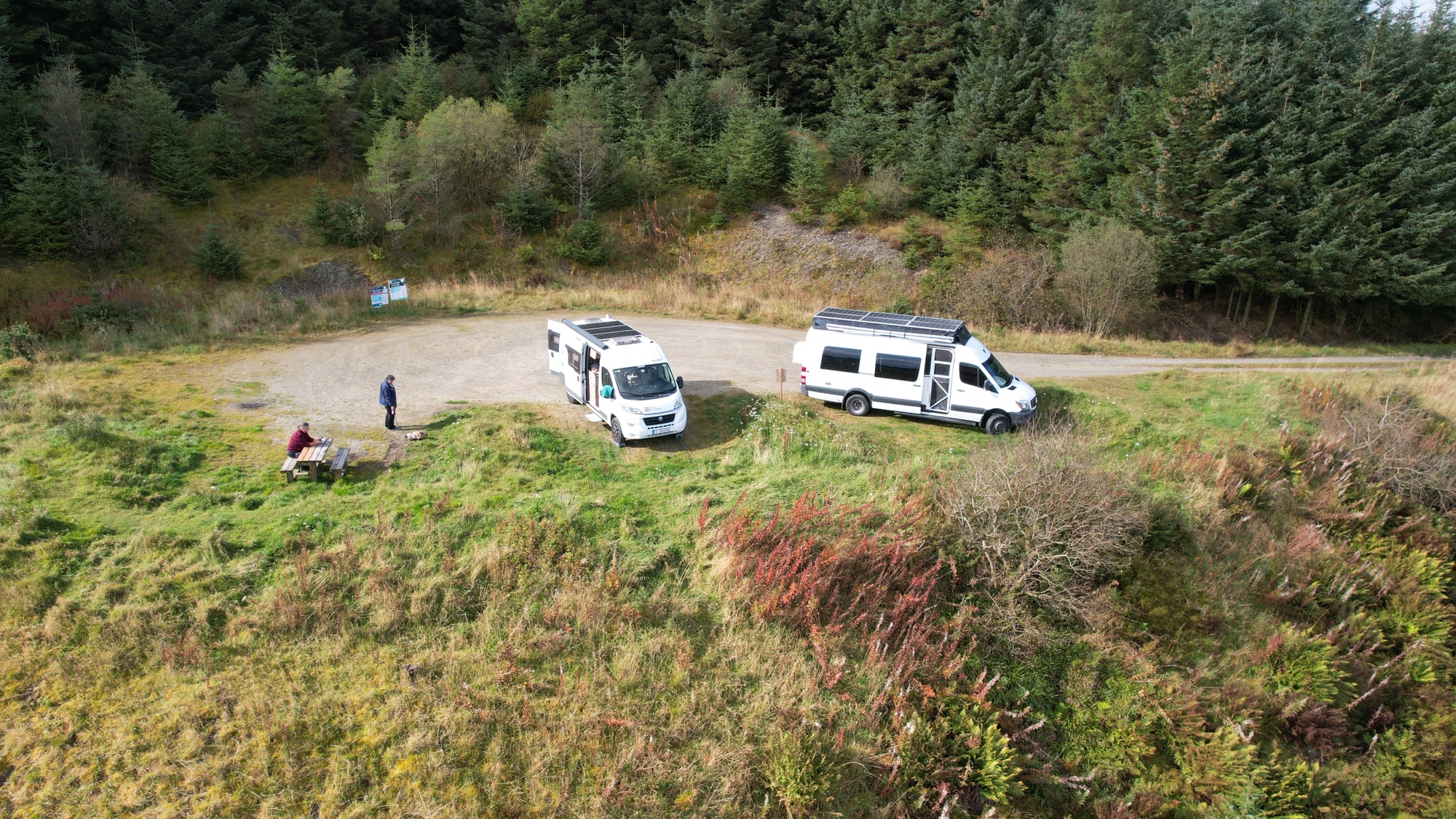


We came back to the harbor at Cairnbulg on a flat gray afternoon, took more or less the same corner of the parking area we had taken the last time, and had the kettle on before either of us said much. A hundred meters away the tide was going out over hard sand. A few small boats were leaning where the water had left them. That is the whole view, and it is the entire reason we keep coming back.
If you go looking for this place on a map you will find two names rather than one. Inverallochy and Cairnbulg sit so close together on the same stretch of coast that you can walk out of one and into the other without noticing you have done it, and the two have kept their separate identities for a few hundred years with no sign of giving them up. Locally the pair are simply called Invercain — a third name, invented rather than chosen, which struck us as a thoroughly Scottish way to settle an argument that nobody wanted to win.
It is about four miles east of Fraserburgh, out on Cairnbulg Point, at the corner where the Scottish coastline stops running north and turns to head west. Corners like that are useful to sailors and dangerous to them in equal measure, and this one has been both for a very long time.

The boat on the rocks
You notice her within a minute of arriving, and after that you cannot stop noticing her. Just offshore, hard against the rocks near the beacon, what is left of a fishing boat lies over at an angle that no boat should ever be at. She is the Sovereign, Banff registered, and she went on there in December 2005, a little after midnight, on the reef the charts call the Cairnbulg Briggs. Every one of her crew got off. The boat did not. The investigation afterward put it down to a lapse of attention on watch, which is a very ordinary way for something enormous to go wrong.
She has been there ever since, going slowly to pieces in front of an audience of dog walkers and photographers. On a calm evening with the light going pink behind Fraserburgh she looks almost decorative, and that is exactly the trap. The Briggs is a low reef running out from the point, marked by a beacon precisely because it is not obvious and not forgiving. The water here is shallow, the bottom is hard, and the wind comes off the North Sea with nothing in its way.
We have found that having a wreck in the view changes how you look at everything else. The harbor is calm. The harbor is also the reason a village needed a harbor.
Boats have been going off this point for a very long time
There has been a castle at Cairnbulg since the 1200s. It began as a Comyn stronghold, passed to the Earls of Ross after Robert the Bruce came through Buchan, and then to the Frasers, who held it for close to three hundred years. The written record of an organized fishing community here starts a little later, in the 1500s, though boats will have been going off this point long before anyone thought to write it down.
What you are actually walking through today is younger than that, and the reason is grim. Cholera went through these villages in the 1860s and the housing was bad enough that much of it was simply cleared and rebuilt to a plan. The rebuilt rows are still there: low cottages set gable end to the sea, so that the weather hits the narrow face of the building rather than the long one, with the gaps between them once used to store boats. It is the architecture of people who had already lost that argument a few times.
The rebuilding coincided with the herring boom, and by the 1880s well over two hundred boats were working out of these two villages. That did not last. Fraserburgh had the deeper harbor and the money, the fleet moved four miles west, and a light railway arrived in 1903 to carry what was left of the trade. It closed in 1965. The harbor you park beside began as a single pier in the 1920s and was only enclosed into a proper basin in the early 1980s, partly out of concrete tank traps left over from the last war — which is the kind of detail that tells you more about the north-east coast than any museum panel.
There is a museum, as it happens, and it is worth the twenty minutes. Maggie’s Hoosie in Inverallochy is the last of the old fishermen’s cottages left in anything like its original state, and it is small in a way that is genuinely instructive if you are living in a van and think you have made a sacrifice. There is also a memorial to those lost at sea. In a village this size, a memorial to those lost at sea is not an abstraction. Somebody walks past it every day who knows a name on it.
A small fair and a folding table
The first thing that undid our expectations here was how quickly people talked to us. Not politely, in the way you get waved through a town that has decided tourists are a manageable nuisance, but properly — asking where we had come from, how long we were staying, whether we knew the tide was about to turn and we might want to move the van a few meters.
At the local fair there was a stall selling seafood landed by the boats we could see from where we were parked. No branding, no story printed on a card, no words about provenance. A folding table, ice, and whatever had come in. The supply chain was about the length of a football pitch.

The starlings, the heron, and the tide
Evenings here have a running cast. The starlings arrive in numbers that make no sense for a village this size and then spend twenty minutes doing the thing starlings do, folding and unfolding over the rooftops and the water, close enough that you hear the whole flock change direction before you see it. The colder months are when the gatherings get properly large. We have stood outside the van with cold hands and let the tea go cold watching it.
Meanwhile a heron works the edge of the harbor with the air of a bird who has decided the seagulls are beneath him and intends to make that clear. He stalks, they object, he ignores them, they object louder. It goes on for as long as anyone is prepared to keep it going.
And underneath all of it, the tide. This is a drying harbor with a hard sand bottom, which means the water leaves entirely and comes back entirely, twice a day, whether or not it suits anybody’s plans. Boats settle onto the sand and stand up again. The view you photographed in the morning is a different view by lunchtime. After a few days you stop checking the clock and start checking the water, which is a small change and does something to your head that is difficult to describe and easy to miss.

Billy, and two of Diane’s birthdays
Billy is one of the local fishermen. He and his wife have now sorted out lobster for Diane’s birthday two years running, which means it has quietly stopped being a coincidence and become a tradition, and neither of us is entirely sure how that happened.
It is not a transaction that feels like one. There is no menu and no markup. The lobster comes out of water we can see from the van, is handed over by the man who took it out of that water, and is cooked in our own small galley a hundred meters from where it was caught. We eat it at our own table with the harbor going dark through the window. We have paid a great deal more for a great deal less in places with tablecloths.

If there is a single thing that has changed about how we eat since we started living this way, it is that. Real food, from real people, prepared simply and eaten more or less where it came from. It is not a philosophy we set out to adopt. It is just what happens when you stay long enough in one place to be handed something.
What it is actually like to stay here
Honestly: exposed. There is a parking area at the harbor and it is a fine place to be, but when the wind swings into the east there is nothing between you and Norway, and you will know about it all night. We would not choose this spot in a bad forecast, and we have moved to the lee of Fraserburgh before now and come back the following day.
It is also a working harbor and a residential village, not a facility. Park where you are clearly not in anyone’s way, keep the slipway clear, and if you are unsure, ask — somebody will tell you, and they will be pleasant about it. There are no services at the harbor to speak of. Fraserburgh, four miles west, has the supermarkets, the fuel, the laundry and the chandlery, so the practical rhythm is a quiet base out here and a run into town every few days.
For walking, there is a circular route of about six kilometers that starts from the harbor parking area, runs out along Whitelinks Bay — a long crescent of sand behind dunes — and comes back inland past the golf course on country lanes. It takes a couple of hours at a normal pace. The beach still has wartime concrete on it, fortifications that the sea has knocked over and tank traps scattered about, which is a strange thing to walk past on a quiet Tuesday and a useful reminder that this coast was once considered the front door.
As for how long to stay: longer than you think. Two nights here will give you a small gray harbor and not much else, and you will drive away wondering what the point was. A week starts to give you the tide, the birds, and the people. That has been true of nearly everywhere we have loved, and we learned it slowly and at some cost.
Nondescript, and not
We understand entirely why most people drive past. There is no visitor center, no headline attraction, no reason for a coach to stop. On a wet afternoon it is a small harbor with a broken boat on the rocks and a row of low cottages turning their shoulders to the weather. Nondescript is a fair description, if you are only passing.
We have been here before and we will be here again. The tide will go out and come back. The starlings will do their thing over the rooftops. The heron will continue his long campaign against the seagulls, and the Sovereign will be a little further gone than she was last time. Somewhere in the village, Billy will be doing what he has always done, four miles from a town that took the fleet and a few hundred years from the people who first pulled boats up this beach.
For most people it is a nondescript little harbor. For us it is a little bit of paradise, and we are in no hurry to explain why to anybody who does not already see it.