
Some mornings on the road are the ones that end up on postcards: a headland, a mug of tea, the sea through the open door. This was not one of those. This was a gravel car park on the edge of Forres, the two of us watching everything we own turn slowly behind glass.
A washing machine is the thing you stop taking for granted
When home is eight square metres, there’s no machine humming in a back room, no basket to let quietly overfill until the weekend. There isn’t the wardrobe for it either. We carry a small, deliberate set of clothes, each one chosen because it earns its place. Which is a fine way to live, right up to the morning most of it is in the laundry bag at once and clean clothes have quietly become a job with a location and a time attached.
So you come to read a town differently. Other people notice the cafés; we notice the launderettes, and keep a running list the way we once kept one of good pubs.
How laundry day works
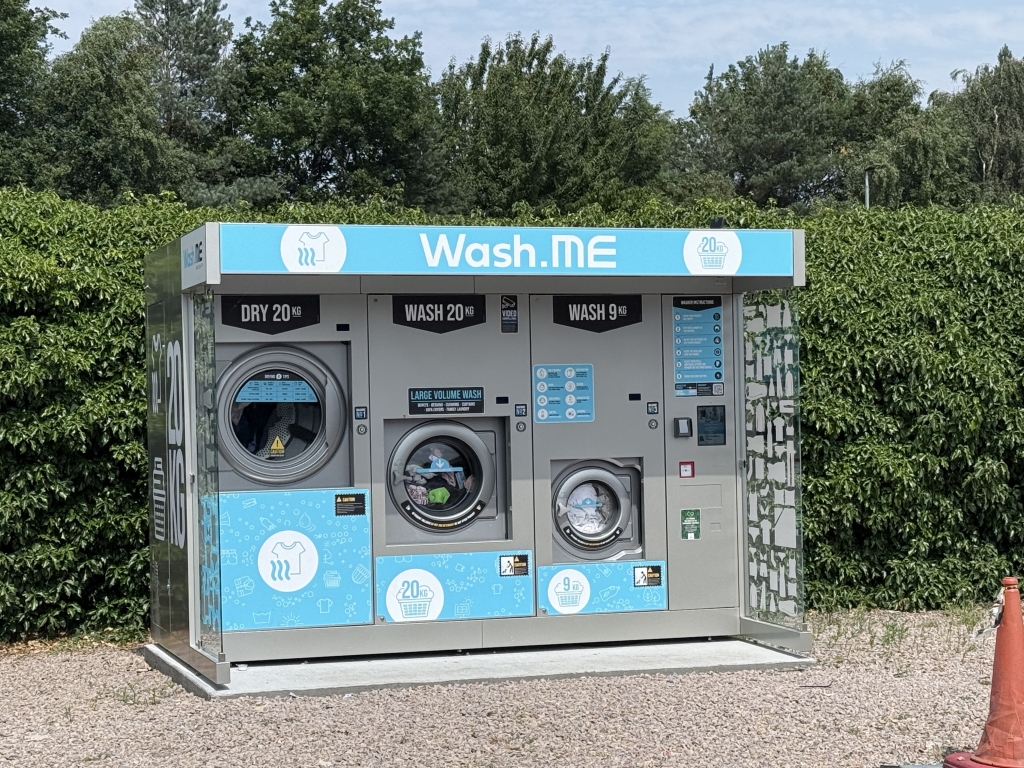
This one was the Revolution Launderette, a bank of stainless machines out in the open beside a filling station, a hedge at their back, gravel underfoot, everything ticking over in the flat northern light. Wash 9kg, Wash 20kg, Dry 20kg, self-service, tap your card and go.
We’ve worked out a rhythm. The whole lot splits across two washers, one card tap each, and then it all goes into a single dryer together, which means a full catch-up of clothes, bedding and towels takes a little over an hour, provided everything fits. The catch isn’t the money or the machines themselves; it’s whether they’re free. Turn up behind someone three weeks into a family’s worth of washing and you don’t start until they finish, and there’s nowhere to be in the meantime but there.
Which is no bad thing, because you’re rarely alone at these places. While the drums went round, the chap at the next machine asked where we’d come in from, told us the good bakery had moved, and steered us off a layby we’d had our eye on: “gets the wind straight off the firth.” Ten minutes, three useful facts, and a conversation we’d never have had at a motorway services. For somewhere so unglamorous, a launderette is one of the more sociable rooms in any town.
The bit we’re still not good at comes afterwards, back at the van. Folding a dryer’s worth of sheets in a space where you can’t fully straighten your arms is its own small comedy, one of us holding an end up by the roof light while the other backs toward the sliding door, both trying not to trail a clean duvet cover across the floor. It gets done. It is never elegant.
There was something fitting about sorting out the small mechanics of a smaller life here. A few miles up the road is Findhorn, where people have been building a community around living simply for more than sixty years. We’ll claim no kinship with a load of washing, but the two ideas sat companionably enough through the afternoon.
Everything clean at once
In a house, something is always dirty: a load in the machine, a heap on the floor, some corner of things quietly waiting. Out here, because we own so little, we get something a house almost never allows: everything clean at the same time. Every shirt, every sheet, every towel, the whole of what we own, washed, dried, and (eventually, awkwardly) folded back into its place by evening.
We drove out of Forres with the van smelling of warm cotton and the particular lightness of a job entirely finished. Clean sheets that night. Clean everything.
It’s a chore, and we won’t pretend otherwise. But it’s a small one, and every so often, in a gravel car park under a wide grey sky, it hands back something the utility room never did.
This was one small day in a long Scottish summer. You can follow the rest in our Scotland journal.