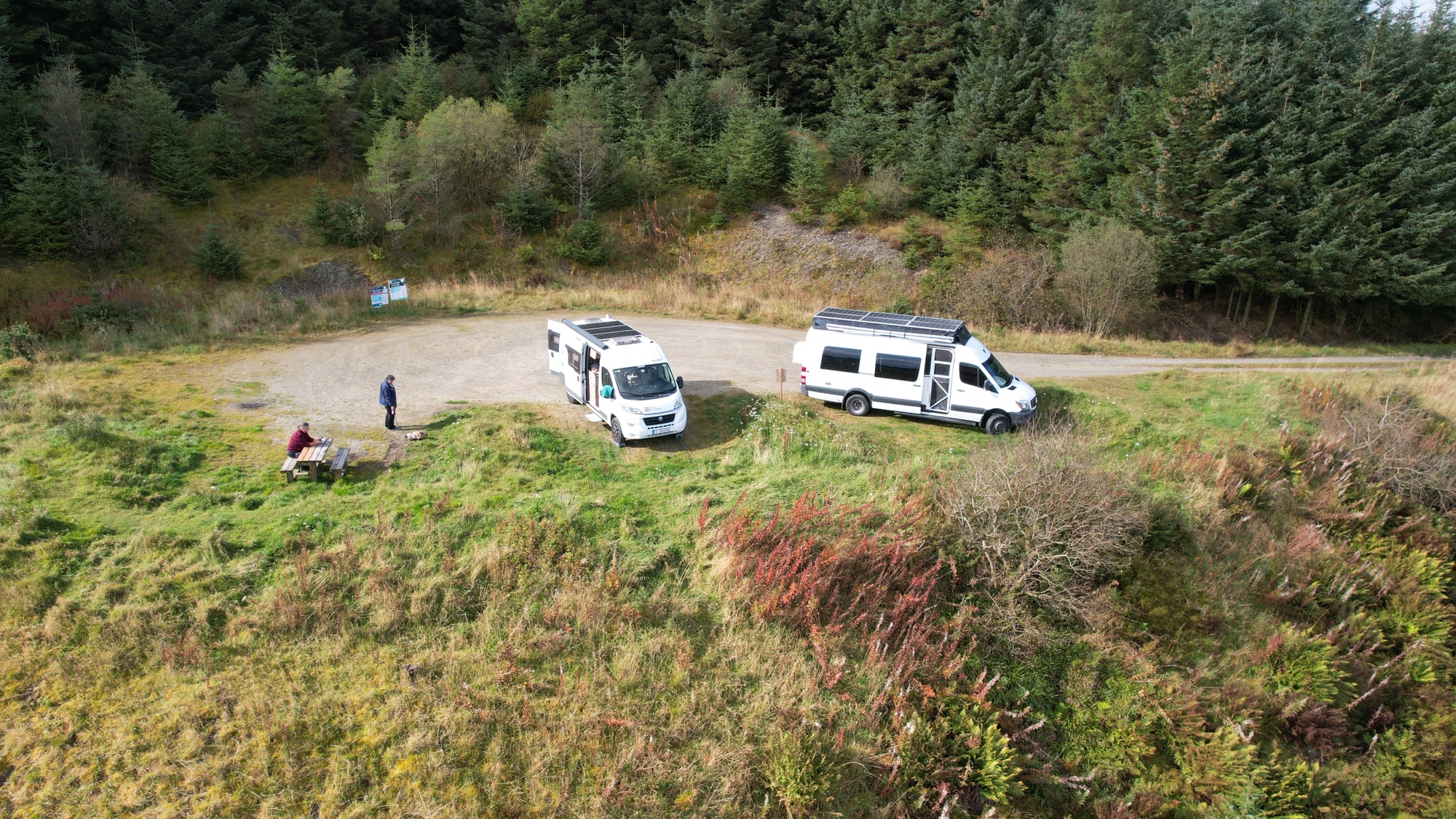

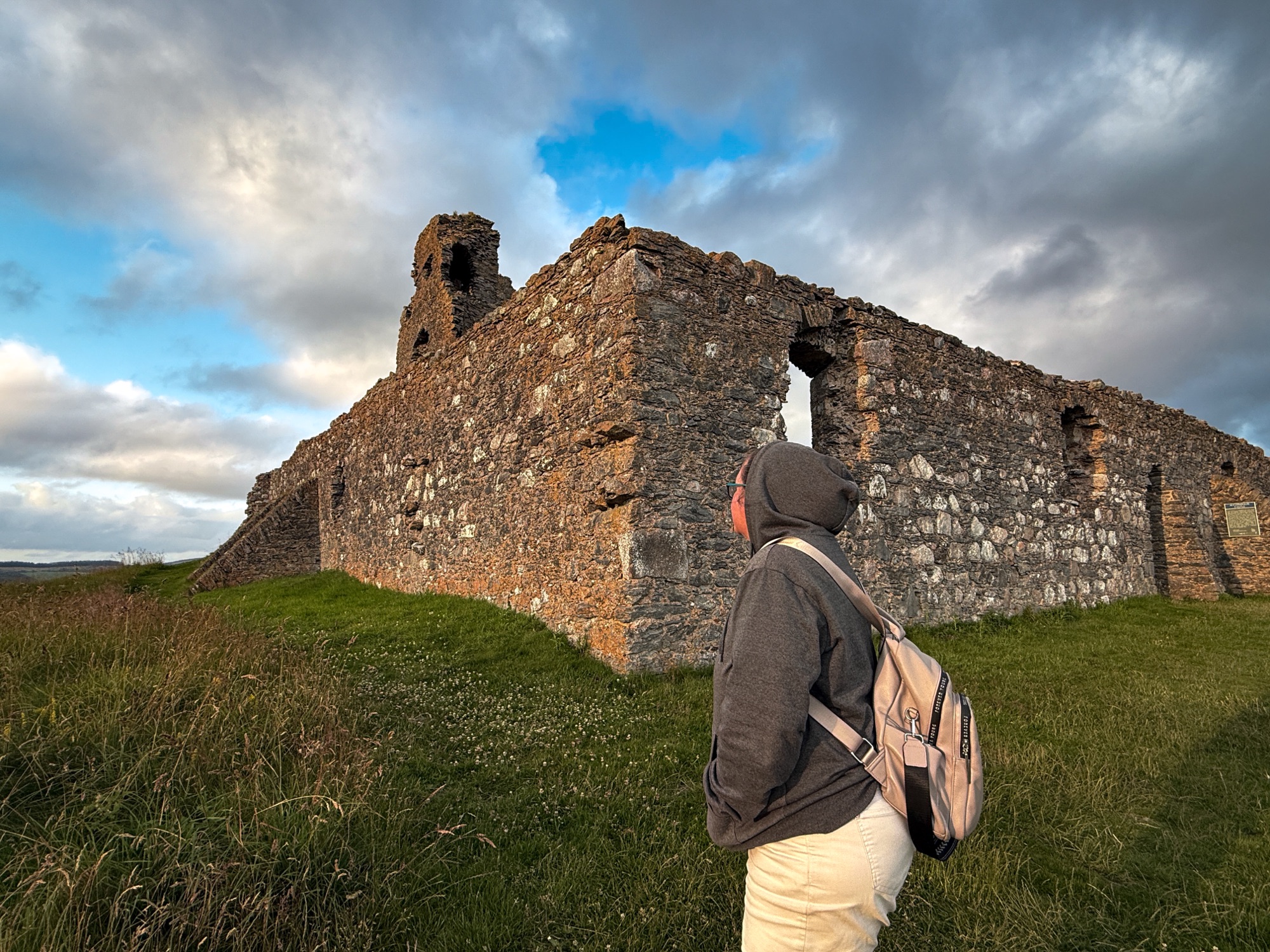
We left Walden on a rough track at the bottom of the hill and walked the last stretch up on foot. That is really the only way to arrive at Auchindoun. There is no car park at the summit, no ticket desk, no little shop selling shortbread and postcards. There is a gate, a green path worn into the slope, and then the tower itself, rising out of the grass where it has stood for the better part of six hundred years, a couple of miles southeast of Dufftown on a hill above the River Fiddich.

There is a particular feeling to walking up to an old Scottish castle rather than pulling into a space beside one. The approach does something to you. By the time you reach the top you are a little out of breath, the wind is in your ears, and the ruin has had time to grow from a grey smudge on the hill into a great hollow tower standing over you. You arrive the way people have always arrived here, on your own two feet, and the place feels earned.
A tower, and something older underneath
Auchindoun is a tower house from the middle of the fifteenth century, a tall L-shaped keep with a high curtain wall and cellars cut straight down into the bedrock. Tradition hands its building to a favourite of James III, a man who came to a bad end, hanged by the king’s own nobles in 1482. Whether his hands ever shaped these stones is uncertain, but the story clings to the place the way stories do.
Walk out beyond the tower and you find the castle is not the oldest thing on this hill. It sits inside the low grassy banks of a far older fort, prehistoric or Pictish, ramparts that were ancient long before the first Gordon ever drew breath. From the ground you can just read them as gentle rises in the turf. From the air they resolve into rings, and the tower sits in the middle of them like a newcomer that turned up a thousand years late.

When you dig, it turns dark
History comes alive in a place like this, and when you dig into it a little you find that some of it was brutal. The castle passed from the Ogilvies to the Gordons, and the Gordons of Auchindoun were not gentle neighbours. In 1571 they rode on nearby Corgarff Castle and burned it with everyone still inside, a horror that Scotland never quite forgot and turned, as it so often did, into a ballad. “Edom o Gordon” is a lovely old tune with a terrible story folded inside it.
The stones remembered, and so did people. Two decades later the account came due. After the Earl of Huntly, himself a Gordon, had the young and popular Earl of Moray killed, William Mackintosh came to Auchindoun and gave it the same treatment the Gordons had given Corgarff. He put it to the torch. He was caught and beheaded for it, and that night became a song too, “The Burning of Auchindoun,” still sung four centuries on. Standing inside the roofless hall, it is not hard to feel the smoke in it.
That is the gift of walking through these ruins slowly, with no timetable and no coach idling in a car park. You have time to let the beauty and the brutality sit side by side, which is nearer the truth of the place than either one on its own. The light through the empty windows is genuinely gorgeous. People also died here, badly, and the walls around us were raised and burned by men who meant every bit of it.

We stayed until the light began to go long, then walked back down to the van. Auchindoun is derelict now, and has been since around 1725, when the good cut stone was carted off to help raise a grander house down the glen. What is left is in the care of Historic Environment Scotland, open to the wind and to anyone willing to make the climb. Nobody charges you. Nobody hurries you. You just walk up, stand in six hundred years of it, and walk back down changed by a degree or two.
Auchindoun is one more chapter in a long, slow Scottish summer. You can follow the whole trail in our Scotland journal.