
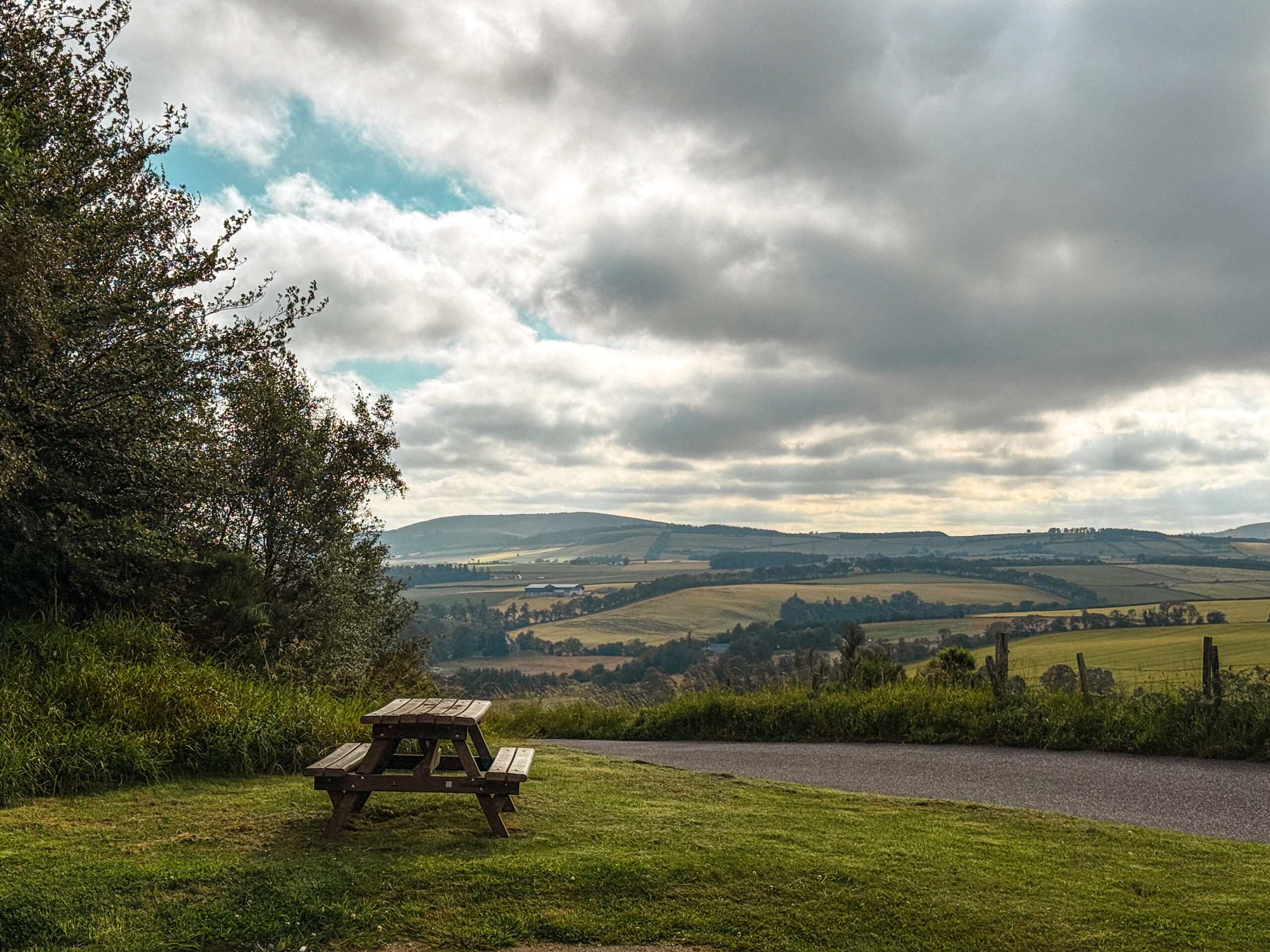
We almost drove past it. That is the honest beginning of most of our best mornings, a spot with nothing to recommend it on any map, a quiet verge on the road out of Keith where we pulled over mostly because we needed to stretch, and stayed because the light was doing something gentle to an ordinary field.
There was no view, in the way people mean the word. No loch, no ruin, no mountain arranged obligingly in the distance. Just grass, a fence, a line of trees keeping the wind honest, and the particular grey-gold light that Moray does on a morning it hasn’t quite decided about. And yet we stood there with our coffee going cold, unwilling to be the ones to break it.
Places that don’t stand out
Scotland has no shortage of grandeur, and we have driven a long way to stand in front of plenty of it. But the famous views tend to come with a car park and a coach, and after a while the spectacular starts to feel a little like being shouted at. What we have come to love out here, in the slow lane of the countryside, is the opposite: the plain places, the ones that don’t ask to be looked at. A hedgerow going quietly about its business. A gate someone mended forty years ago and never bothered to paint. Rain caught along a fence wire and strung out like glass beads, holding the whole grey sky in each drop.
There is a discipline in this that we did not expect to learn. When you live in a van, you cannot outrun the ordinary, most of any day is small and practical and unremarkable, the same as anyone’s. So you either find the beauty in the plain hour or you spend your life waiting, a little sourly, for the extraordinary one to arrive. We chose to look. It turns out that is most of the secret: not going somewhere more beautiful, but paying closer attention to wherever you already are.
What “simple” holds
Stand still by that field near Keith for ten minutes and it stops being empty. The grass is not one green but a dozen, moving in slow shifts as the wind reads it. A blackbird works the hedge with the seriousness of someone doing a proper job. There is the smell of wet earth and cut grass and, faintly, our own diesel cooling behind us. Somewhere a long way off a dog decides something is worth barking at, and then decides it isn’t. None of it is going in anyone’s guidebook. All of it is, quietly, enough.
The trick, if it is even a trick, is to stop asking a place to be more than it is. The field does not owe us a rainbow. Once we let it simply be a field on a soft morning, it gave back far more than we had any right to expect, which is, we are starting to think, how most good things work.
Why we keep doing this
People sometimes assume the van is about escape, running off to somewhere better than the ordinary life. It has turned out to be almost the reverse. What it has really taught us is how to stay put for a moment longer, in a plain spot on a plain day, and notice. Beauty, we have decided, is far less a matter of location than of attention. You can carry the ability to find it, or you can leave it behind; it weighs nothing either way, and it fits easily in a van already full of everything else we own.
Eventually the coffee really was cold, and a tractor came round the bend to remind us we were parked on someone’s working morning. We waved, pulled the door shut, and drove on toward the next unremarkable place. It had given us exactly what the grand ones give, and asked for nothing in return but that we slow down enough to see it.
This corner of Moray is one of many places we have written about in Scotland. The whole collection lives in our Scotland journal.