
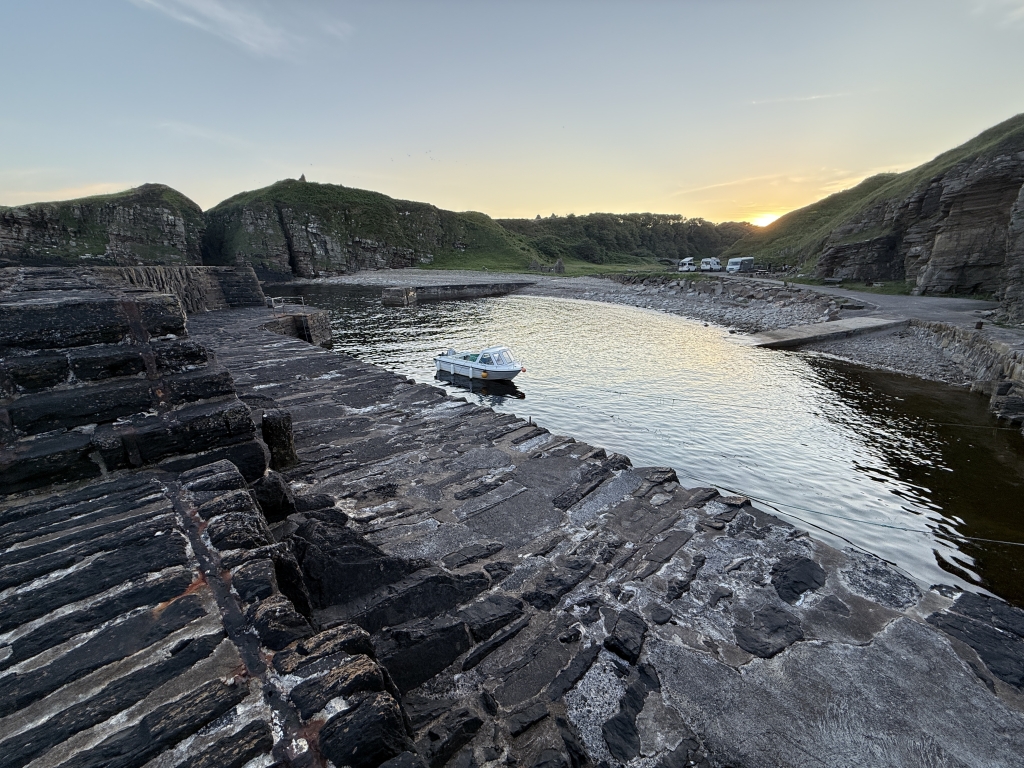
We turned off the A9 late in the afternoon, down a narrow lane signed to the harbour, and within half a mile the NC500 and its convoy of motorhomes had vanished behind us. At the bottom, where the Burn of Latheronwheel runs out to meet the sea, there is a small stone harbour, a handful of parking spaces, and, on the evening we arrived, nobody else at all.
What the name actually means
“Latheronwheel” looks like a puzzle and turns out to be two ideas stitched together. It comes from the Gaelic Latharn a’ Phuill, roughly, “the muddy place of the pool.” Latheron is the muddy ground; the “wheel” is an anglicised echo of a’ Phuill, the pool where the burn slows and gathers before the sea. Say it aloud a few times and the older name starts to surface underneath the map spelling.

A harbour that used to be busy
It is hard to picture now, but this was once a working place. The harbour was built around 1840, and in its herring years close to fifty fishing boats crowded in and out of this small, rugged cove. The trade drifted away to bigger ports before the First World War, and what is left is the best kind of quiet, a disused lighthouse on the south headland, an old stone bridge from the 1720s still standing for anyone crossing on foot, and water that simply gets on with the tide.
An overnight by the water
We put the kettle on and let the evening do the rest. The burn talked away to itself over the stones, a few gulls argued and then thought better of it, and the light slid down the valley and out across a sea the colour of pewter. It is the kind of stillness you can almost hear, no traffic, no neighbours, just the small machinery of a place minding its own business.

It is not a campsite, and that is the point. There are no hook-ups, no services, no tap, just a few spaces beside the water, so you arrive self-sufficient and you leave the place exactly as you found it. The far north keeps its own weather, too: the wind found us in the small hours and rocked the van gently on its springs, which, parked beside a harbour, felt about right.
The best stops are the ones you turn off for
The NC500 has a way of hurrying you along, the next viewpoint, the next distillery, the next lay-by already full of vans. Latheronwheel was a good reminder that the nights worth having are usually a mile off the route, down a lane that doesn’t look like much, at a place that was busy a hundred years ago and is perfectly content not to be now. We made coffee in the morning, watched the tide come back up the burn, and were in no hurry at all to leave.
Latheronwheel is one of many quiet corners we have found in Scotland. See them all in our Scotland journal.